
On 6 March from 11 a.m. to 1 p.m., Ag Tanz und Elternschaft (Dance and Parenthood working group) is offering an info Zoom session on the Kids and Caregivers Rider for interested venues and event organisers
The Rider was developed by Ag 2023 as a recommendation for action and offers practical and concrete tips on how events can be designed to be family-friendly.
Initiated as an information and exchange format, the event on 6 March offers the opportunity to get into conversation and further advance the implementation of family- and parent-friendly event formats, especially in the dance sector.
Please register in advance by email to: kontakt@tanz-und-elternschaft.de (please also use the email contact for any queries)
The link to the event will then be sent to you.
The information session will be held in German.
Please get in touch if you are interested in an information session in English, we will then schedule another session.
Initiated as an information and exchange format, the event on 6 March offers the opportunity to get into conversation and further advance the implementation of family- and parent-friendly event formats, especially in the dance sector.
Please register in advance by email to: kontakt@tanz-und-elternschaft.de (please also use the email contact for any queries)
The link to the event will then be sent to you.
The information session will be held in German.
Please get in touch if you are interested in an information session in English, we will then schedule another session.
About Ag Tanz und Elternschaft: https://tanz-und-elternschaft.de/en/about-us/
Link Kids and Caregivers Rider:
https://tanz-und-elternschaft.de/…/kids-and-caregivers…/
Link Kids and Caregivers Rider:
https://tanz-und-elternschaft.de/…/kids-and-caregivers…/
Netzwerktreffen Tanzvermittlung – #1 Access Check.
Thursday, 14th of December 2023, 2 – 7 pm
Tagungshaus Alte Feuerwache, Kreuzberg
What is the status quo of access in the field of dance? What are good practices that have made a difference in recent years? What are the biggest barriers and how can we overcome them together? We would like to address these questions by looking at institutional and artistic-mediating practices.
The network meeting builds on our concept for a Berlin dance mediation centre, Access Point Dance/Tanzvermittlungszentrum, in which the terms Vermittlung and Access are strongly linked. The Netzwerktreffen Tanzvermittlung – #1 Access Check is the first of a series of regular network meetings in the field of dance mediation and serves to promote links and exchange.
Keynote guests include:
Hannah Aldinger (Access-Work and art mediator)
Angela Alves (Dancer and choreographer)
Lucia Matzke (Krump dancer and dance mediator)
Bahar Meric (Co-Founder of Future Move e.V.)
Elisa Ricci (Project manager of Offensive Tanz für junges Publikum)
Diana Thielen (Activist dance maker and mediator)
Moderation: Leila Haghighat (Cultural scientist and art mediator)
Registration until 10th of December at: info@access-point-tanz.org
Address
Tagungshaus Alte Feuerwache
Axel-Springer-Str. 40/41
10969 Berlin
Directions
U8 Moritzplatz
U2 Spittelmarkt
U6 Kochstraße
Bus M29 and 248 Lindenstraße/Oranienstraße
ACCESS INFORMATION
The network meeting will be held in German, with English translation available if required. Participation is free of charge. DGS translation is available. The seminar room of the Tagungshaus Feuerwache is accessible for wheelchair users and can be reached with an elevator and a ramp. Wheelchair-accessible bathrooms and toilets with wide doors without doorsteps are available.
Please let us know your access needs when you register.
(de) Workshop: Dismantling Barriers for a Better Work Culture in Dance Making and ‘Tanzvermittlung’
Get labelled: Parents in Theaters!
Get labelled: Parents in Theaters!
Since July 1, the Ag Tanz und Elternschaft (working group Dance and Parenthood) of the ZTB is working in several labs and in exchange with other artists, networks and initiatives and in collaboration with three Berlin venues to develop criteria and best-practice models that enable parents interested in dance/art to participate as an audience. Among other things, formats that have emerged during the pandemic since 2020 will be evaluated. The working group is developing a Kids Rider and a family-friendly label from this. The results of the funded Artist Lab will be presented, among other things, on October 20/21 at the meeting of the Nationwide Artist Labs B.A.L.L. at Kampnagel in Hamburg.
The Nationwide Artist Labs are a measure of the Fonds Darstellende Künste, financed with funds from the Federal Government Commissioner for Culture and the Media within the framework of NEUSTART KULTUR.
More info on the working group: https://tanz-und-elternschaft.de/en/
“How to (Make) Dance in Berlin – A Toolbox for a Better Work Culture in the Independent Dance Scene”
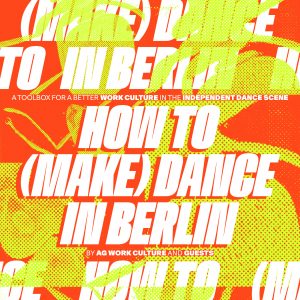
We are happy to share the digital booklet “How to (Make) Dance in Berlin – A Toolbox for a Better Work Culture in the Independent Dance Scene” by AG Work Culture and Guests – a bottom-up initiative operating within Zeitgenössischer Tanz Berlin e.V. The booklet is available in German and English.
Since the 1st of March 2021, a group of more than twenty cultural workers – representing freelancers and employees of art institutions connected to the local independent dance scene – has been meeting on a regular and voluntary basis online and offline to map the challenges of Berlin’s work life and to share strategies of collaboration and organisation. “How to (Make) Dance in Berlin – A Toolbox for a Better Work Culture in the Independent Dance Scene” testifies to the urgent need and willingness to transform the ways we work and how dance exists within the work and art markets.
The publication provides guidelines and offers some practical tools to be used directly in the studio, art and dance institutions, and all activities around dancemaking. It is a collection of our ideas and open-source materials that emerged during a collective process. It proposes a baseline for the healthy collaboration between professionals in Berlin’s independent dance scene as we strive for structural improvement.
We will be thankful if you share the booklet with your networks. Please don’t hesitate to contact us, if you have further questions: agworkculture@gmail.com
AG Work Culture (Angela Alves, Olympia Bukkakis, Rike Flämig, Beatrix Joyce, Enrico L’Abbate, Matthias Mohr, Ania Nowak, Benjamin Pohlig, Anna Romeo, Mateusz Szymanówka, Simone Willeit, Kasia Wolińska)
The booklet is available in German and English
We are happy to share the digital booklet “How to (Make) Dance in Berlin – A Toolbox for a Better Work Culture in the Independent Dance Scene” by AG Work Culture and Guests – a bottom-up initiative operating within Zeitgenössischer Tanz Berlin e.V. The booklet is available in German and English.
Since the 1st of March 2021, a group of more than twenty cultural workers – representing freelancers and employees of art institutions connected to the local independent dance scene – has been meeting on a regular and voluntary basis online and offline to map the challenges of Berlin’s work life and to share strategies of collaboration and organisation. “How to (Make) Dance in Berlin – A Toolbox for a Better Work Culture in the Independent Dance Scene” testifies to the urgent need and willingness to transform the ways we work and how dance exists within the work and art markets.
The publication provides guidelines and offers some practical tools to be used directly in the studio, art and dance institutions, and all activities around dancemaking. It is a collection of our ideas and open-source materials that emerged during a collective process. It proposes a baseline for the healthy collaboration between professionals in Berlin’s independent dance scene as we strive for structural improvement.
We will be thankful if you share the booklet with your networks. Please don’t hesitate to contact us, if you have further questions: agworkculture@gmail.com
AG Work Culture (Angela Alves, Olympia Bukkakis, Rike Flämig, Beatrix Joyce, Enrico L’Abbate, Matthias Mohr, Ania Nowak, Benjamin Pohlig, Anna Romeo, Mateusz Szymanówka, Simone Willeit, Kasia Wolińska)
The booklet is available in German and English
AG work culture, AG Tanz und Elternschaft
𝐈𝐍𝐅𝐎-𝐓𝐀𝐍𝐙 // AG Tanz und Elternschaft | Info-Treffen
Termin: 22.11.2022, 13-15 Uhr
Ort: Cornus Remise, Gustav-Adolf-Str. 159, 13086 Berlin
In den vergangenen zwei Jahren war die AG im Gespräch mit Förderinstitutionen, Jurymitgliedern, Residenzorten sowie mit Künstler*innen, Organisationen, Vereinen, Initiativen und Netzwerken, die sich für bessere Arbeitsbedingungen von Tanz-/Kunstschaffenden in Elternschaft einsetzen. Diese Erfahrungen und Informationen möchte die AG mit euch teilen. Jede*r, die*der daran interessiert ist, Tanzschaffende in Elternschaft zu unterstützen, ist willkommen!
Den Link zur Anmeldung und weitere Infos findet ihr auf tanzraumberlin.de:

AG Work Culture
Lab 3 – working culture: Angela Alves, Olympia Bukkakis, Ulrike Flaeming, Beatrix Joyce, Matthias Mohr, Ania Nowak, Benjamin Pohlig, Rilaben, Mateusz Szymanówka, Simone Willeit, Kasia Wolinska.
With the warmest thanks to Makisig Akin & Lena Szirmay-Kalos, Mateusz Szymanówka & Kasia Wolinska, ZTB e.V., PSR-Group and Radialsystem.
Choreographic Convention VIII is a production by UFERSTUDIOS GmbH as part of the European network project Life Long Burning, co-funded by the Creative Europe Programme and the Kofinanzierungsfonds of Berlin’s Senate Department for Culture and Europe. Lab 3 WORKING CULTURE is organized as a cooperation with ZTB e.V. and Radialsystem.
Public Event: 11.11.2022: 11:00 Uferstudios Heizhaus
Public Event: 19.11.2022: 18:00 Radialsystem
Public Event: 19.11.2022: 18:00 Radialsystem
Note: This event will be in english.
Die Choreographic Convention VIII, WHAT/SPACE:CHANGES/CULTURE, ist eine Versammlung von Choreograph*innen, Tänzer*innen, Performancekünstler*innen, Schriftsteller*innen, Forscher*innen, Kurator*innen, künstlerischen Leiter*innen und Produzent*innen, um sich zu treffen und über Themen rund um die Frage “Welche Art von Raum kann Veränderungen in der Tanzarbeitskultur fördern?” zu reflektieren.
Die Frage lenkt die Aufmerksamkeit auf einen notwendigen Diskurs im Bereich des Tanzes in Bezug auf Künstler*innen und Kulturschaffenden, die asymmetrisch von globalen strukturellen und sozialen Problemen betroffen sind, einschließlich, aber nicht beschränkt auf Fragen des Rassismus, des Abelismus, der Frauenrechte, der Rechte von Transgender, der Kriegsführung, der Auswirkungen des Kapitalismus und der anhaltenden Covid-Pandemie. Im Rahmen der Choreographic Convention wird auch die AG work culture des ZTB ihre Richtlinien zu einer nachhaltigen Arbeitskultur vorstellen.
Die Frage lenkt die Aufmerksamkeit auf einen notwendigen Diskurs im Bereich des Tanzes in Bezug auf Künstler*innen und Kulturschaffenden, die asymmetrisch von globalen strukturellen und sozialen Problemen betroffen sind, einschließlich, aber nicht beschränkt auf Fragen des Rassismus, des Abelismus, der Frauenrechte, der Rechte von Transgender, der Kriegsführung, der Auswirkungen des Kapitalismus und der anhaltenden Covid-Pandemie. Im Rahmen der Choreographic Convention wird auch die AG work culture des ZTB ihre Richtlinien zu einer nachhaltigen Arbeitskultur vorstellen.
Lab 3 – working culture: Angela Alves, Olympia Bukkakis, Ulrike Flaeming, Beatrix Joyce, Matthias Mohr, Ania Nowak, Benjamin Pohlig, Rilaben, Mateusz Szymanówka, Simone Willeit, Kasia Wolinska.
Mit herzlichem Dank an Makisig Akin & Lena Szirmay-Kalos, Mateusz Szymanówka & Kasia Wolinska, ZTB e.V., PSR-Group and Radialsystem.
Die Choreographic Convention VIII ist eine Veranstaltung der UFERSTUDIOS GmbH im Rahmen des des europäischen Netzwerkprojekts Life Long Burning, mit Mitteln des Creative Europe Programms und des Kofinanzierungsfonds der Berliner Senatsverwaltung für Kultur und Europa. Lab 3 WORK CULTURE ist eine Kooperation mit ZTB e.V. und Radialsystem.
Öffentliche Veranstaltung: 19.11.2022: 18:00 Radialsystem
The election touchstones about dance, Berlin 2021
Today, we are pleased to publish the election touchstones („Wahlprüfsteine“) initiated together with the network TanzRaumBerlin for the upcoming Bundestag elections as well as the elections for the House of Representatives in Berlin. Both elections will take place on Sunday, September 26, 2021.
The Wahlprüfsteine are our means of asking the parties standing for election for position papers on pressing cultural policy issues. We have received a response from all local divisions of the parties contacted by ZTB e.V. and Netzwerk TanzRaumBerlin – the SPD, CDU, Bündnis 90/Die Grünen, Die Linke as well as the Free Democratic Party. We would like to take this opportunity to thank them once again for responding.
The TanzRaumBerlin network and the ZTB e.V. have jointly formulated five Wahlprüfsteine, each with two to three questions. These include topics such as the continuation and further development of initiatives launched for the “continuity of artistic work”, the “strengthening of decentralized infrastructure” and a “new central institution for dance”, but also the strengthening of the positions of the Round Table Dance („Runder Tisch Tanz“) and the further development and reorientation of funding instruments. We publish the Wahlprüfsteine and the questions in the appendix together with the answers of the parties.
Both Wahlprüfsteine and the responses have been originally formulated in German language. Attached you can find both also in English language.
The upcoming federal elections as well as the election for the House of Representatives in Berlin are crucially important for the further development of cultural policy in the state and the federal government. Please inform yourself about the positions of the parties. Form an opinion and participate actively in discussions. We will gladly accept your suggestions, ideas and demands in the future. Also contact the member of parliament responsible for your area and seek a discussion. And above all: Go vote!
Kultur Räume Berlin: Two dance rehearsal rooms “Georg-Knorr-Straße”
Kultur Räume Berlin, represented by Kulturraum Berlin GmbH, awards two subsidized, newly renovated rehearsal/production spaces for dance in Georg-Knorr-Str. 4 in Berlin-Mahrzahn to professionally working artists within the framework of the Arbeitsraumprogramm (ARP, previously supervised by the Senate Department for Culture and Europe) and in cooperation with Gesellschaft für StadtEntwicklung gGmbH. 4 in Berlin-Mahrzahn from June 2021.The location has very good public transport connections: S7 (station Berlin-Mahrzahn, connection to S-Bhf Ostkreuz), streetcar 16, 27, M6, M17 (station Gewerbepark Georg Knorr, connection to S-Bhf Landsberger Allee).
The rooms are located on the 1st floor of a former factory building, on the same floor are, among others, the new Seneca Intensive Studios. The lease is expected to start on 01.06.2021.
Rehearsal room Nr. 1: dance room 123,78 m2 + office 28,68 m2 (plus showers, toilets) -> total monthly costs incl. electricity 997,17 €.
Rehearsal room Nr. 2: dance room 83,03 m2 + office 8,85 m2 (plus showers, WCs) -> total monthly costs incl. electricity 616,84 €.
The rooms are spanned by two beams, at these points the clear room height is 3.46 m and 3.86 m respectively, the door width is 1.25 m in each case. All walls are painted white, the screed floor is covered with a light gray matt color coating, and in the two dance rooms there is a sprung floor and dance carpet.
Detailed information about the rooms can be found here. (Info sheet as pdf for download see below).
Individual artists as well as user groups/associations of up to five tenants per room can apply. The rooms are allocated for 12 or 24 months, extensions are possible up to a maximum of four years. The selection will be made by a sector-specific, independent awarding advisory board for performing arts and dance within the framework of the ARP.
The two viewing dates on 13.04. and 27.04.2021 will take place digitally only.
Pre-registration is required with Kulturraum Berlin GmbH via the following link https://kultur-raeume-berlin.everreal.co/app/public/listings
Visiting dates:
13.04.2021, 16.00-17.30 (online via Zoom)
27.04.2021, 16.00-17.30 (online via Zoom)
Application deadline: 09.05.2021
Infoblatt of Kultur Räume Berlin (German): Vergabe von zwei Tanzräumen+Büro_Georg-Knorr-Str. 4_Infoblatt Kulturraum Berlin GmbH März 2021
With this CryptPad, Kulturraum Berlin GmbH offers the possibility for self-organized networking as a community of users: https://cryptpad.fr/pad/#/2/pad/edit/dPX2YXJ9zv-inZyZPDSbjWeT/
It works like a bulletin board, here contacts to other applicants can be searched for in order to clarify or find communities of users in the run-up to the application